Short answer
In slab homes, which are very common around McKinney, the main house shutoff is usually on a garage wall, on an exterior wall near the front hose bib, or in a small box in the yard between the house and the street. Turn a lever handle a quarter turn so it sits across the pipe, or turn a round wheel handle clockwise until it stops. If you can't find or close your own valve, call the City's Water/Wastewater line at 972-547-7360 rather than opening the City's meter box yourself.
If water is pouring out right now
- Close the nearest valve you can find. If the leak is from one fixture (a toilet, a sink, the water heater), its own shutoff valve is faster than the main. See fixture valves below.
- If you can't isolate it, close the main house shutoff. Locations are listed in the next section.
- Turn off the water heater's energy source if the whole house is shut off for more than a short while: set a gas heater to "pilot" or "vacation", or switch off the breaker for an electric one. This protects the heating element if the tank drains.
- Open a faucet at the lowest point of the house (a bathtub or an outside hose bib) to drain pressure from the pipes and slow the leak.
- Stay away from water near outlets, extension cords or appliances. Only switch off a breaker if you can reach the panel without standing in water.
Where to find your main shutoff in a McKinney home
The City of McKinney explains that homeowners should know where their own shutoff is, and that it is usually in the garage, a crawl space, or near the foundation. In practice, for the slab-on-grade homes that are very common in North Texas, check these places in order:
- Garage wall. Look on the wall that faces the street, often low down near the water heater or behind storage shelves. You're looking for a copper, PEX or PVC pipe coming up out of the slab with a valve on it.
- Exterior wall near the front hose bib. Many North Texas builders put the house valve just above or beside the front outside faucet. Sometimes it is inside a small plastic or metal cover.
- A valve box in the front yard. Some homes have a separate, round or rectangular box with the homeowner's valve inside, closer to the house than the meter.
- Utility closet or next to the water heater. Common in townhomes and some older or custom builds.
- Older homes with crawl spaces. Some of McKinney's historic homes near downtown have pier-and-beam foundations, and the valve may be under the house where the line enters.
The City's meter box is not your shutoff
The water meter usually sits in a box near the street or sidewalk. According to the City, the meter and the valve between the meter and the street belong to the City, and only City staff may operate that valve. If your own house valve won't close, or the leak is between the meter and the street, call the City's Water/Wastewater line on 972-547-7360. The City's website lists this as the number for main breaks, meter leaks and overflowing sewer mains, and it is answered 24/7 by the City.
How to close the valve
Ball valve (lever handle)
Most homes built in the last few decades have a ball valve with a flat lever. When the lever is in line with the pipe, water is on. Turn it a quarter turn so the lever sits across the pipe and the water is off. It should move with firm hand pressure. Don't hammer on it.
Gate valve (round wheel handle)
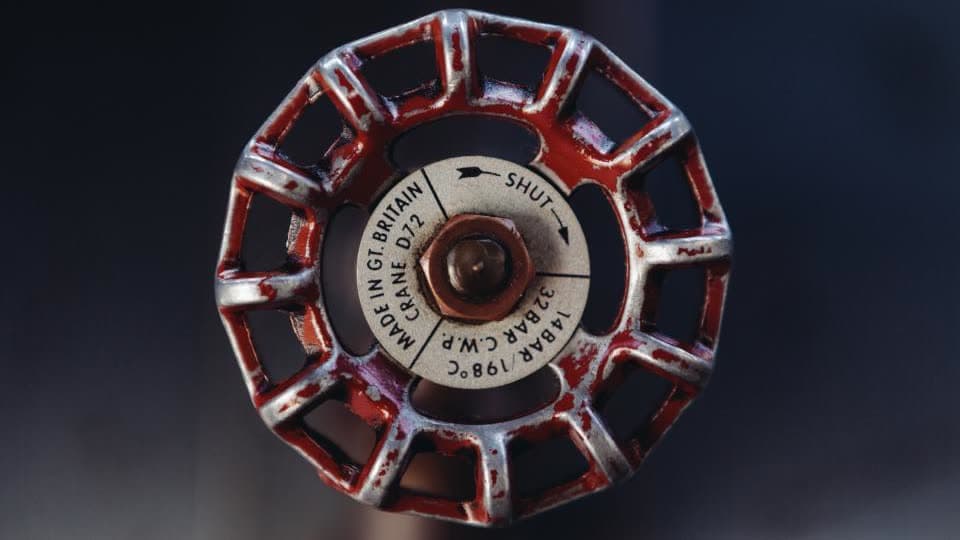
Older homes, and some newer ones, have a round handle. Turn it clockwise until it stops. It may take many turns. If it is stiff, use steady hand pressure first. Gate valves that haven't moved in years can break internally, so if it spins freely without stopping the water, stop and call the City or a plumber.
How to tell it worked
Open a faucet inside the house. Flow should slow to a trickle and stop within a minute or so as the pipes drain. A little dripping is normal. Strong continuous flow means the valve isn't fully closed or you've found the wrong valve.
Fixture valves: stop one leak without shutting off the house
Every fixture should have its own small shutoff. Using these keeps water on for the rest of the house.
- Toilets: an oval or round handle on the wall or floor behind the toilet, on the supply line. Turn clockwise. See our leaking toilet guide.
- Sinks: two small valves under the sink, one for hot and one for cold. Turn both clockwise.
- Dishwasher: usually shares the hot-water valve under the kitchen sink.
- Washing machine: two valves in the laundry box behind the machine, or lever valves that close together.
- Refrigerator ice maker: a small valve under the sink, behind the fridge, or in the garage near the water heater.
- Water heater: the cold inlet valve on the pipe entering the top of the tank. Closing it stops water feeding a leaking tank. See water heater leaking from the bottom.
- Irrigation system: McKinney sprinkler systems have a backflow preventer, usually near the house or the meter, with its own valves. Closing the irrigation shutoff isolates the sprinkler lines without affecting the house.
What if the valve won't turn?
- Don't use a long pipe or cheater bar for extra leverage. You can snap the valve or crack the pipe below it, which turns a controlled problem into an uncontrolled one.
- Try a fixture valve closer to the leak if there is one.
- Call the City on 972-547-7360 if you need water stopped at the meter. Explain that your house valve won't close.
- Once the emergency is over, have a plumber replace the stuck valve. A house shutoff that doesn't work is worth fixing before you need it again.
Test your shutoff twice a year
A shutoff you've never used is a shutoff you can't trust. Pick two dates, for example when clocks change in spring and fall:
- Find the main valve and make sure you can reach it. Clear stored items away from it.
- Close it fully and confirm a faucet stops.
- Open it fully again. On a gate valve, back it off a quarter turn from fully open so it doesn't seize.
- Show everyone in the house where it is. Consider a tag or a photo on your phone.
- Do the same for the water heater cold inlet and the irrigation shutoff.
Before winter, this matters even more. During the February 2021 winter storm, many North Texas homeowners found out where their shutoff was only after a pipe had split. Our burst pipe guide covers freeze preparation.
When to call a plumber
- The main valve is seized, leaking from the stem, or won't fully stop the water.
- You can't find a house shutoff at all. Some homes genuinely don't have an accessible one, and a plumber can add one.
- A leak is inside a wall, ceiling or under the slab. See leak detection and slab leak signs.
- A pipe has burst. See burst pipe repair.
If you do call, tell the plumber whether the water is currently off, where the leak is, and what type of valve you have. That helps them bring the right parts.
Frequently asked questions
Can I turn off the water at the meter myself?
The City of McKinney says the meter and the valve between the meter and the street belong to the City and only City staff may operate that valve. Use your own house shutoff, and if it won't work, call the City's Water/Wastewater line on 972-547-7360.
Which way do I turn the valve to shut off the water?
For a lever (ball valve), turn it a quarter turn so the handle sits across the pipe. For a round wheel (gate valve), turn it clockwise until it stops. Righty-tighty, lefty-loosey applies to both.
Should I turn off my water heater when the water is off?
If the water will be off for a while or the tank might drain, yes. Set a gas unit to pilot or vacation, or switch off the breaker for an electric unit. Running an electric heater with an empty tank can burn out the element.
Is it safe to leave the water off while I wait for a plumber?
Yes. The only downside is inconvenience. Keep a few jugs of water for drinking and flushing. Flushing a toilet by pouring a bucket of water into the bowl works fine.
How do I turn the water back on without damaging pipes?
Open the main slowly, over about 30 seconds, with a faucet or two open. This lets air escape and reduces water hammer. Close the faucets once the water runs steadily without sputtering, and check the repaired area for drips.